

Blog
Interview: Leta Popescu & Diana Mihalașcu / UNITER
"I'm not expecting any award, I don't even think about it. (…) I'm glad I worked with Leta, who was my teacher. I'm glad I came home with a list of notes on directing and dramaturgy, and that I learned something."
This year's UNITER Awards Gala brings our Reactor colleagues three nominations in three different categories. We talked with them, asked how they relate to this nomination and what expectations they have. Fingers crossed for them!
We continue with the third and last interview, with Leta Popescu and Diana Mihalașcu, nominated in the Best Romanian Dramatic Text Staged in World Premiere category, for the text "Lalele, păsări și beton", after texts by Ovidiu Cioclov, Doina Gecse-Borgovan, Katia Nanu, Maria Orban, Oana Paler, Laura Stanciu, Livia Stoica, Dana Voicu.
1. What does this UNITER nomination mean to you? How does it feel in relation to your work so far?
Diana Mihalașcu: This nomination was a surprise for me. I didn't expect to be put forward for UNITER as a playwright, "Lalele, păsări și beton" being the first play I've written to get this kind of visibility. I used to write only for myself and never seriously thought about what this step means. I feel that my work, even if it's not in the field I'm most active in, is being taken into account. I don't do theatre for awards, but it's nice to know someone noticed the effort.
I wrote at Leta's invitation and I don't know if this marks the start of a new path in theatre or whether I'll ever write again. I took it as play, I approached the process like a challenging exercise, and that helped me. I didn't sit down at the table with the pressure of having to finish a play or write something worthy of UNITER. Just as "playing is about playing", writing is about writing. I wrote, I laughed, and now I'm glad. I'm not expecting any award, I don't even think about it. I feel at peace with having done my duty toward this show as best I could. I'm glad I worked with Leta, who was my teacher. I'm glad I came home with a list of notes on directing and dramaturgy, and that I learned something. Gathering information is the most valuable award for me.
Leta Popescu: A surprise. I thought LIRDA, a text I wrote at Comedie, would draw more attention from the guild. Especially since it's a more tightly built text, though it's true, it has a (more) classic structure. "Lalele…" is a text written by me and Diana after many authors, a text that also dictates the show's aesthetic, or rather a text born from the aesthetic I was planning to try out. I don't think it's a good text, I think the show works well as a whole. It's a successful installation that weaves together text, movement, acting, set design and concept. It's strange how what they extracted from this show was… the text.
2. Do you think anything will change for you if you win or if you don't win? Have you thought about a possible speech if you get the award?
D.M.: The UNITER nomination brought me more exposure, but I don't think it will bring about a fundamental change. I make theatre because that's what I want; I direct because it's the only channel of artistic expression I have. For me, theatre is a necessity. I didn't write this text with other people's awards in mind. I've made shows that got no attention at all, but that expressed so many ideas that they, in fact, "made" me. I'll keep making theatre with the same honesty and joy as before. My dedication, my aspirations and my work won't change because of any award. It's important for accolades to be just a chance side effect, not a starting point. My thirst is for knowledge, not for recognition. I make theatre not to prove I can, but because I can't do anything else.
I haven't thought about the speech yet. I'll most likely write it a week before, or whenever I feel the need to put a series of thoughts on paper. The best speech I've heard recently was Wagner Moura's: "If trauma can be transmitted across generations, then values can too". I don't know what else there is to say after a statement like that. I don't believe in a recipe for speeches. Indeed, the stage means exposure, attention. I have a lot to say, I'll probably say something, but there's also a chance I say nothing. I believe in being fair to myself, so I'll only speak if I feel the need to. Speeches are a final stage; I work, and I have a lot to say IN and THROUGH my work.
L.P.: I don't think we'll win, and if we do, nothing changes for me. Maybe for Diana, since she's just starting out. Either way, nobody really cares about the text awards, there's such a gulf between text and directing, oh boy! The text award is an excuse for people in the audience to step out for a smoke. We could get into that another time, so I'm not just being cynical without having time to back it up too. Anyway, if someone has to go up on stage, I'll let Diana go alone, let people see her, remember her, because she deserves it.
And I'll ask her to thank Reactor on my behalf, the space where I felt creative because I felt loved. A space where being honest with the world, with yourself, with art was always a priority. Reactor's principles went into me like a youthful vow. Not the political ones. The human ones. Oana and Doru. They paved my way with courtyard tiles, and every now and then some little creature crawls out from between them and keeps me standing upright.
3. Tell us a bit about working on the text "Lalele, păsări și beton", about the experience of co-writing, and also about the whole show. What is this type of dramaturgy like for you, and the discourse the text delivers?
L.P.: I've co-written before, but this time it was somehow the easiest. I wrote with Diana out of exhaustion. I couldn't do it alone anymore. I wrote with Diana because Diana, at one point, wrote a passage better than mine. I made room for Diana to write better than me.
D.M.: It was an experience I don't know if I'll have again anytime soon. Leta had already sketched out the first two acts and suggested I write the next scene. I realized from the start that I had to adapt to her writing style, which was the most demanding requirement of the whole process, though, paradoxically, it was easier than if I'd written alone. At first I tried to get into the atmosphere the working team had settled into, thinking about the notes Leta had given the actresses. I picked up on aspects of a way of thinking that had formed around this subject. From the first days I noted down two defining words Leta had used during rehearsals: change and power. The dramaturgical abstraction she had already built intrigued me, and I incorporated it into my work.
What helped me most was my ability to understand what a show needs. It might sound strange, but I wrote thinking I was Leta, the Leta of this show. I re-read the passages she wrote as if they were mine, keeping this question in mind: "what in me triggered the need to write these lines?". In the mornings I came to rehearsal in a room full of women, working on a show about women. The actresses guided me too, without knowing it. I watched them, the women in front of me, my colleagues I was working with. I'd go home and write with their faces in mind, with their stories and their jokes. I was like a sponge, and I marveled at how "full" I was by the end. I wrote searching within them, within everything around me, and I learned a lot about myself. Yes, Leta was right; it's about change and power.
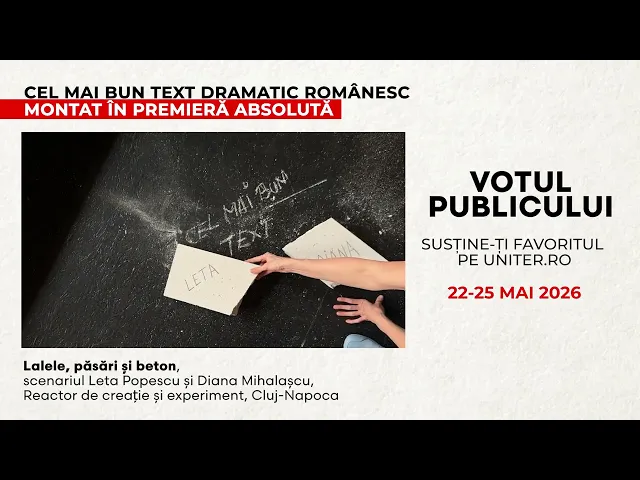
If you want to support Leta and Diana for the Audience Vote, you can vote for them between May 22-25 at www.uniter.ro.
Here's the support video:
