
Our Stage Blog!
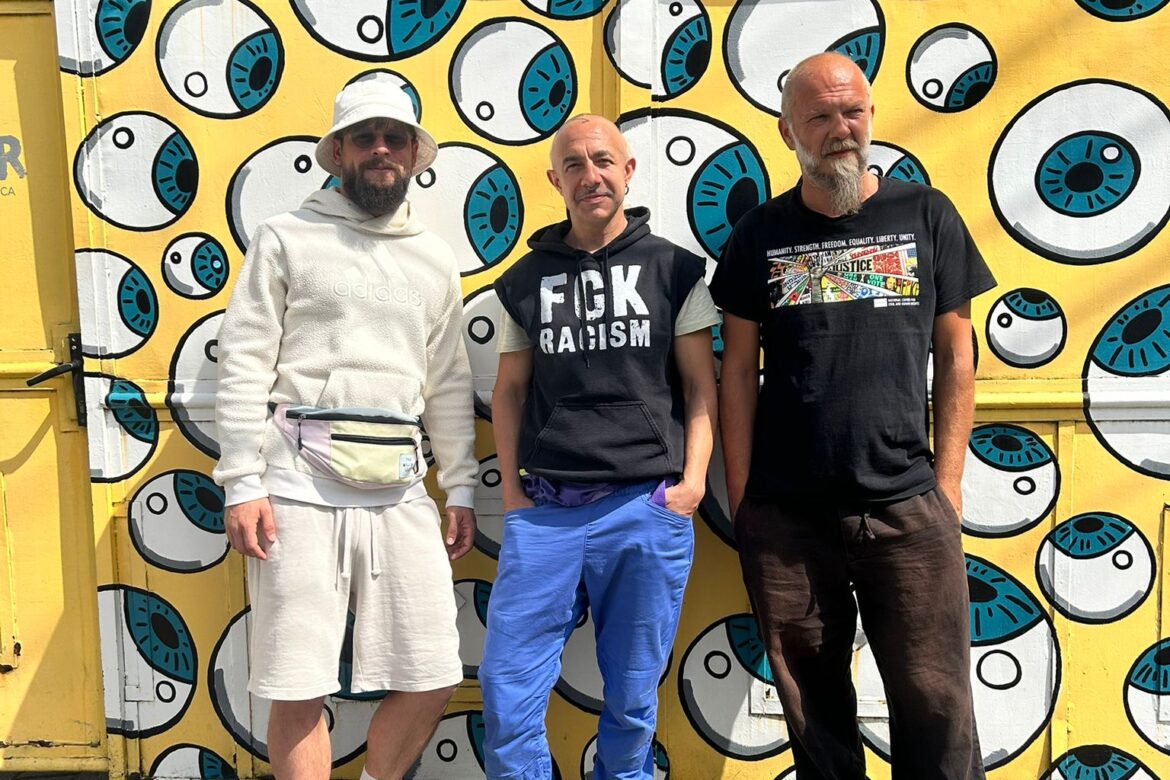
Radu Dogaru, Çağlar Yiğitoğulları, and Mihnea Blidariu - On the magic of complementary encounters!
At the beginning of October, the premiere of the one-man show "Thus Spoke Zarathustra" is ready to greet the public! It's the delightful result of a highly intriguing artistic combo: actor Radu Dogaru, interdisciplinary artist Çaglar Yigitogullari (Turkey/Germany), and original music composed by Mihnea Blidariu. To find out what the creative process was like, we invited the three of them to share some of their magic with us!
What captures your interest when you start working on a theatrical production? Are there certain expectations? Is there something you wish to discover as a theatre artist or through artistic research? What is currently on your mind regarding your work? Feel free to answer whichever questions inspire you!
Çağlar Yiğitoğulları: I am always interested in, influenced, or inspired by the things happening around me and in the world. That is why I so appreciate contemporary theatre and performances where there is always more room to listen to the artists or people involved in the production, which rarely happens in conventional theatre. There, it is not about research, but rather the sheer need and desire to create.
My way of staging or presenting things on stage is to encourage or gently challenge the audience to feel and think beyond the mere aspects of the issues we bring to light. That is why all possible art forms, such as sound, text, movement, etc., are essential to elevate the creation to its brightest level. My main concerns are linked to our daily lives rather than theatre itself or art in general. In daily life, I sometimes feel like a monkey escaping its cage, startled by everything happening around it. There are too few things in life that bring us pure joy. That is why my artistic work is not meant to be simply pleasant, but rather deeply stirring. I believe that is the true role of art, especially the role of theatre today!
Radu Dogaru: I am fascinated by how a show comes together, what resources are truly involved in that, and to what extent we can guide those resources. I know it sounds simple, but it is what keeps me awake at night! Before we started working on "Thus Spoke Zarathustra," I was constantly wondering what I had to offer, what I could do all by myself on stage. So, what occupies my mind most as an actor is finding a voice, a method, or a path to making theatre that is truly worth listening to—and I believe every project is a brilliant, unmissable chance for that search.
Mihnea Blidariu: I "arrived" in state theatre almost 13 years ago, invited by Ada Milea as a musician-performer, and I have happily collaborated with her on several musical theatre shows ever since. Before that, however, I composed the music with Andrei Puiu for a one-man show based on my own poetry texts, "mânia.Ro", starring Paul Socol. About 3 years ago, I collaborated with Çağlar for the first time. In the meantime, I also composed the music for another wonderful one-man show at Maidan, based on texts from my novel, "Playlist for the End of the World", with Cătălin Florea. So, I would say I have different expectations and interests depending on the context and the people I work with. The more I resonate with the subject, the director, the actors, and the working environment, the higher my expectations and the greater my enthusiasm! Generally, I seek to understand the directorial vision deeply, not as a bystander, but as an active participant. If I have the chance to work with musically talented actors, I am interested both in what I can create sonically for the character and what the actor "feels" like doing musically. After all, they are the ones stepping into the character's shoes! I don't expect everyone to always agree with me or simply validate me; I am collaborative enough to compromise, but also subversive enough to try and "slip" my ideas in if I meet resistance... Of course, it is important to me that the text does not conflict with my principles and values, and in the case of an independent production, I look at the funding sources. Oh, and of course, I hope, as much as possible, to participate in an artistic act that creates a lively reaction, dialogue, and maybe even pushes the boundaries!
Radu, in the case of the performance "Thus Spoke Zarathustra," it is a one-man show where it is just you and the stage. Is this a different performative experience compared to your previous work? What challenges and joys have emerged for you as a performer?
R.D.: It is definitely a performative experience I have never tried before, beyond the fact that it is my very first one-man show! The texture of the show, its demands, and the performance keys are entirely new to me, even though I have worked with Çağlar Yiğitoğulları several times. I believe an actor's primary tool is attention, and Çağlar gave me the confidence that my focus, with enough patience, has the power to transform an ordinary gesture into a deeply meaningful one. Whatever the nature of a theatrical show, its essence can be read as a musical score of attention: where is the attention focused? How much attention is invested? When does attention land on a fact, a gesture, or a person? When is it held? When is it released? Can we stand on stage without being attentive to anything at all? And for how long?
Our collaboration was wonderfully efficient. Çağlar arrived incredibly well-prepared, and after just a few days of work, we knew quite clearly what we had to do, which is an amazing comfort for an actor. It is so satisfying to see that after working together a few times, you begin to speak the same language! The biggest challenge was that, being alone on stage, I had to push myself out of my comfort zone. It was an excellent lesson! But I am absolutely thrilled. I expect the show to be warmly received by the audience. I am so happy and grateful to be working once again with the Reactor team and its wonderful audience!
How did the creative process for the show's music unfold? What inspired you, Mihnea?
M.B.: It was a surprisingly prolific and smooth process! Well, maybe not so surprising, given that the three of us complement each other beautifully in our artistic ideas and attitudes, but still, we could hardly believe there wasn't a single clash in our creative dialogue.
First and foremost, I was inspired by Çağlar’s directorial approach, his artistic, philosophical, and even political vision. Then came the story itself—a story I will let the audience discover for themselves, because it isn't necessarily (or only) what the title might suggest! I was also inspired by the actor Radu Dogaru and the wonderful way he understood and embraced Çağlar's artistic proposal. And finally, I was inspired by the things happening in my own life during the creation of this show, some of which seemed to connect, by a beautiful coincidence, with the art we were creating.
What was the creative process like for you, Çağlar, considering you were working in a foreign language?
C.Y.: The "space" and freedom that Reactor offered us were extremely precious. I truly had the opportunity to do everything I wished. Generally, I work on the concept of "taking risks"—physically, emotionally, and politically. But, of course, artistic risks are involved too. There was plenty of room for all of this during our rehearsal process for "Thus Spoke Zarathustra." Guided by this freedom and the desire to create something we all loved, we felt an immense joy to work on the show. That is why the process was so precious and productive! Language is never an obstacle for me, because in a way, I am always lost in translation. I love in Turkish, think in German, and dream in English. For me, it is entirely possible to create a show without using any spoken language at all, especially when collaborating with people I like, admire, and appreciate. This is just another beautiful way of taking risks, and without risk, there is no progress!
This is the fourth time you are all working together. Have you discovered something new by working in this formula now?
R.D.: Yes, it is the fourth time I am working with them, but it is the first time the concept of the show is very close to what Çağlar produces and performs in Germany. This makes me incredibly happy because, although I have loved all the projects we've done, I have always been curious about the style of theatre Çağlar creates for himself.
M.B.: I would say we have deepened an artistic and human relationship that has flourished for several years now. Radu is not only a fantastic and versatile actor, but also a talented musician; more than anything, I had to learn that "less is more" with this show in regard to him, as it was hard not to try and exploit his talents to the maximum! With Çağlar, I am on the exact same wavelength in so many ways—artistically, humanly, politically. There is only one challenge in working with him: everything overflows with ideas, buzzes with personal experiences, and weaves personal life with that of the characters, and I am the type of artist who absolutely loves such challenges! I wished to compose music for the theatre, and now here I am, in the middle of a wonderful journey, so every new experience adds something extra, whether it's something you want to adopt or let go of. I will happily continue part of this artistic journey alongside Çağlar and Radu—we will make an exciting announcement about this in the near future! We warmly invite you to the shows, to discover us, them, and yourselves!
C.Y.: Every meeting, reunion, or collaboration brings something fresh, because we are constantly changing and bringing new things to the table. And most of the time, it is delightfully unexpected and interesting, because we choose to stay and create together. Regarding your question about languages, this proves that language isn't everything. We need something deeper than words, and that is artistic expression in our encounters.
Performance produced within the cultural project "Spaces of Growth". Cultural project co-funded by the Administration of the National Cultural Fund. The project does not necessarily represent the position of the Administration of the National Cultural Fund. AFCN is not responsible for the content of the project or the way the project results may be used. These are entirely the responsibility of the beneficiary of the funding.
Project realized with the support of the City Hall and the Local Council of Cluj-Napoca.
