

Our Stage Blog!
Selma Dragoș - on parents and resources
In July, we present the staged reading SCHOOL RUN/ CURSA, a text written by Selma Dragoș following research into what it means to be a parent/mother in Cluj, into the efforts and compromises parents are capable of for their children. The result of this research is based on interviews and workshops led by Selma, whom we asked to answer a few questions about the whole process.
How did this project come about? What was the context for you, and why this interest in the work of parenting?
Selma Dragoș: Last summer, at Gianina Cărbunariu's workshop at Reactor, we talked about the anger of a lady in my neighborhood. She curses the cars every morning at the same hour. And about my own anger and bewilderment that it's exactly the people looking for a better world for their children who make the city less friendly for others. Most of the cars blocking the sidewalks in my neighborhood belong to parents from a private kindergarten and school. The kind of school where they practice an education based on respect for the child. And exactly those people show zero respect for the space where other parents with children live.
I teamed up with Oana Mardare and we did interviews with mothers from the city who were willing to talk to us about what they want for their children, where they get their models from, what they would NOT do for their children.
The working title became "Mothers Shaping the City".
My interest isn't just civic outrage. It also comes from disappointment in myself as a parent who has made compromises. For example, 2 years ago my son and I made a list of high school options - the high schools he wanted to get into all had an admission average over 9.50. To get those extra hundredths of a point on the National Assessment exam, you have to take private tutoring. I believe this system of parallel preparation is a very toxic and inequitable practice. What do you think I chose?
I stuck to my principles, giving my son a life lesson
I paid for tutoring, but kept my fingers crossed behind my back, so it wouldn't count
I started a campaign against private tutoring, mobilized an impressive number of mothers and teachers, and together we put an end to this practice
How did the research period for this text go? How did you structure it?
S.D.: After the summer interviews I started collecting topics and dialogues from mothers' groups and articles. I felt I wanted to write not about the subjective experience of motherhood, but about the mother-citizen experience, of the parent-as-player in a game you play for your child's benefit. And for that I needed someone who could see the parents' path "from above".
This spring I brought Vlad Alexe on board the project, a sociologist who studies urban rhythms. I told him what was on my mind and showed him fragments from the interviews I'd taken. That's where my research exploded. Vlad made a list of perspectives and concepts that made me cry. I want to capture this contrast between the subjective experience, where you probably feel the problem lies with you, and the view from above that says "this is the game". After meeting Vlad, the working title became "School run" - an expression I couldn't find a perfect equivalent for in Romanian
Vlad also came up with the idea of the city as a labyrinth and with proposals for ways to interact with the audience.
I spent a lot of time online, in parents' groups. I've noticed for a few months now that when someone asks for advice, more and more often people show up in the comments who've asked the same question to an AI and then post the answer in the comments. The answers always seem very rational, and it's hard to say anything more convincing.
So I also had conversations, sometimes with ChatGPT, sometimes with Gemini and Thaura, on the topic of "what's the best parenting strategy in Cluj-Napoca", based on material available online - social media groups, articles, communications from authorities (city hall, school inspectorate, police). With that input, the output was the voice of a capitalist, smart city, ready to tell you, in a polite tone: "if you can't manage, you can always leave. There are less competitive places where you'd do better."
I recognized inflections of this voice in my own child and in teenagers I've met - 14-year-olds who already see their lives in terms of a CV to build and time as a resource to invest. And they use Artificial Intelligence as a career counselor. I saw, at the school where I worked this spring, that even 5th graders use the AI answers available for any search, they don't even look at other results anymore, it's a little pocket advisor they trust a great deal.
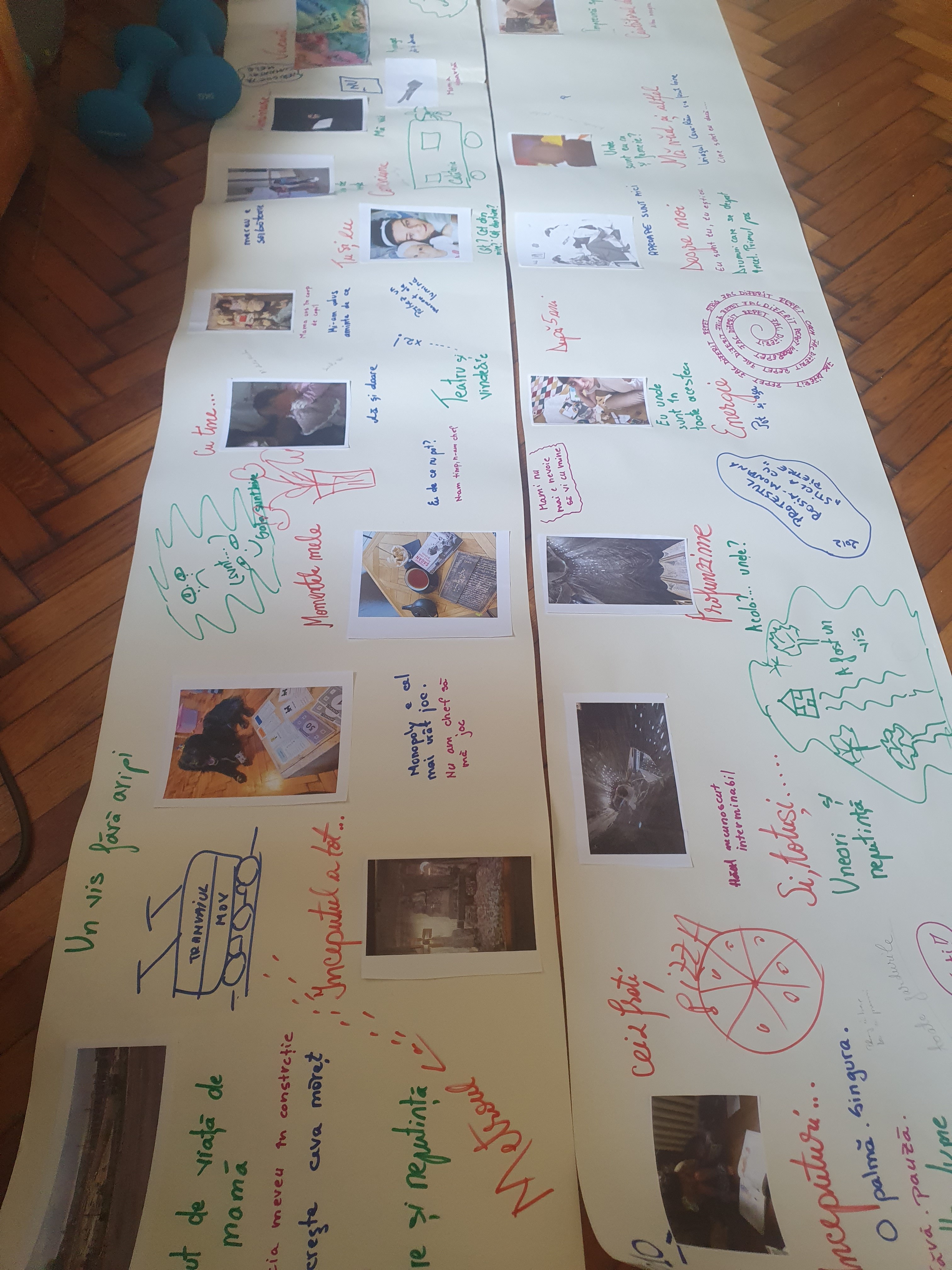
Tell us about what the workshop experience with parents was like for you. What were you looking for? How did you think through the workshop's structure? What are the results?
S.D.: By the time I got to the workshop with parents, it was clear to me that there are two very important lines along which the game unfolds: time - as a limited personal resource, and space - the city, as a shared, limited resource, from which we all want different things at the same time. I was also hoping that, by the end of the workshop, the participants would agree to let me draw on their texts.
Since Mihai Păcurar was going to facilitate two of the workshops on cohabitation, a topic he's long been concerned with, I chose to structure my workshops around the theme of time.
Some of the workshops took place on Thursdays, at QUB, at the County Library headquarters, scheduled to run in parallel with a workshop for children, and the other part at Reactor.
I was surprised and not surprised by the fact that only mothers came to the workshop. And by the fact that it's very difficult for all of us to be in the same place, at the same time. The main challenge for the structure I had planned was adapting to however many of us were in the room at each session.
I aimed to gather "reports from the city's labyrinth" in different voices, from different perspectives, and to achieve this by offering a space where we use writing as a tool for self-exploration.
What surprised me the most, when I made a kind of timeline of motherhood, was that I had forgotten about one shared experience - the pandemic. I realized in that session that we were representatives, in the room, of opposing positions that were born back then. I get the feeling that a new kind of loneliness was also born then - we migrated online and never fully came back.
What changed over this period, compared to what you originally set out to do, and what came up in the research, in the interviews, or in the workshops?
S.D.: I don't think it changed, it just became very complex and very unwieldy. And I'm at the point where I should give something up. Letting go is all the more difficult because I feel obligated to include every perspective from all these encounters.
As I write, I have dozens of notes and slips of paper with pieces of text spread across the floor. I'm not ready to tell you what I've kept, because I haven't cut anything yet.
Tell us a few words about the text and about the July reading. Why the choice to work with amateurs and not professional actors?
S.D.: For me, what's at stake in the reading is testing several paths: different ways of interacting with the audience and different registers for the story.
The reading is part of the workshops for developing the text together with the community I want to speak with and about.
I proposed this approach because it lets the workshop participants get to know Reactor through people and working methods. And it lets me watch up close the reactions of the people I'm addressing.
